
NOMAD · Eur. Phys. J. C 63, 355–381 (2009)
A study of quasi-elastic muon neutrino and antineutrino scattering in the NOMAD experiment
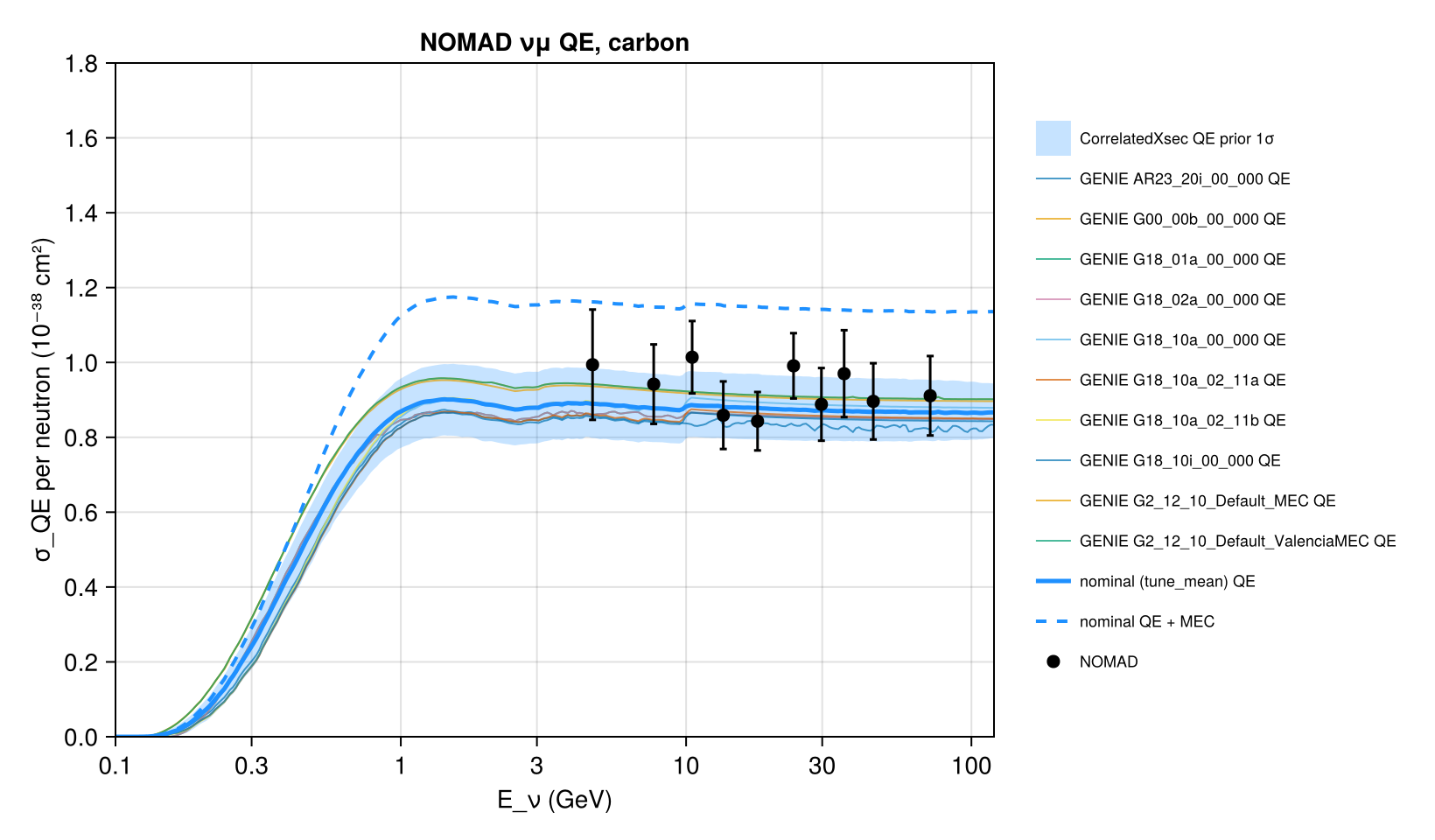
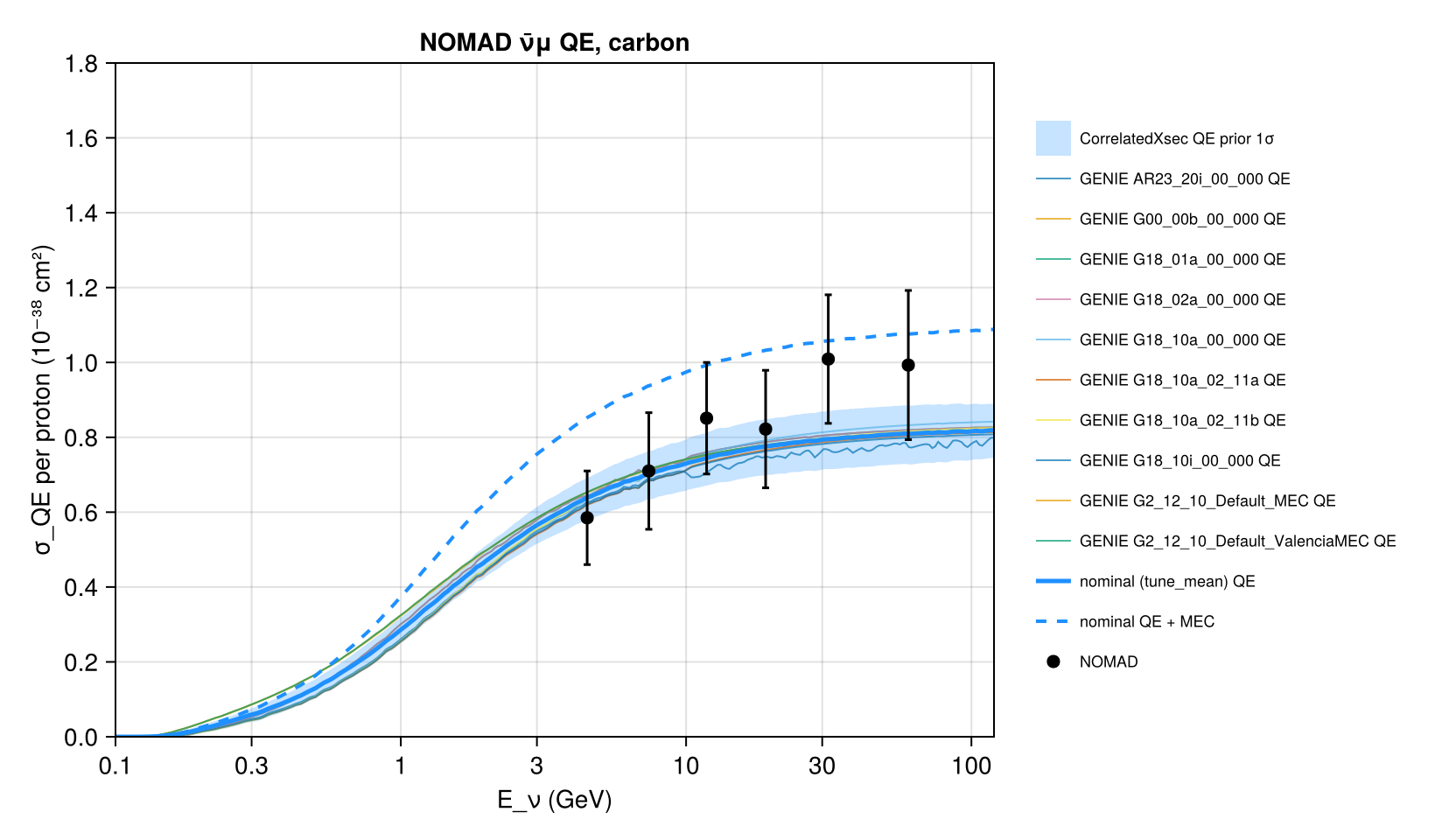
The quasi-elastic νμ (per neutron) and ν̄μ (per proton) cross sections on NOMAD's mainly-carbon target, 3–100 GeV, and the νμ result converted to a free neutron, together with the deuterium bubble-chamber measurements the paper compares to (ANL 1977, BNL 1981, FNAL 1983; NUISANCE data files), compared with the quasi-elastic cross sections carried by Newtrinos.jl (module xsec): the ten GENIE tunes of generator_sigma (process QE) on carbon and on free nucleons, and the nominal model of CorrelatedXsec (the mean of the tunes) with its prior 1σ band, which includes the axial-mass knob (xsec_ma_qe, ±10 %). On carbon the data are on average 6 % (ν) and 10 % (ν̄) above the nominal QE (χ² = 5.7/10 and 3.2/6; 3.2 and 2.6 with the prior band); the nominal QE + MEC (shown dashed) lies above the data at high energy, as NOMAD's selection (one or two tracks) suppresses 2p2h only partially. On free neutrons the nominal describes the deuterium data from 0.2 GeV and NOMAD's converted points (χ² = 4.2/10, data/model 1.04).
Figures
νμ quasi-elastic σ per neutron of carbon: NOMAD vs the GENIE tunes and the CorrelatedXsec nominal (QE, and QE + MEC) · Fig. 14 (ν)
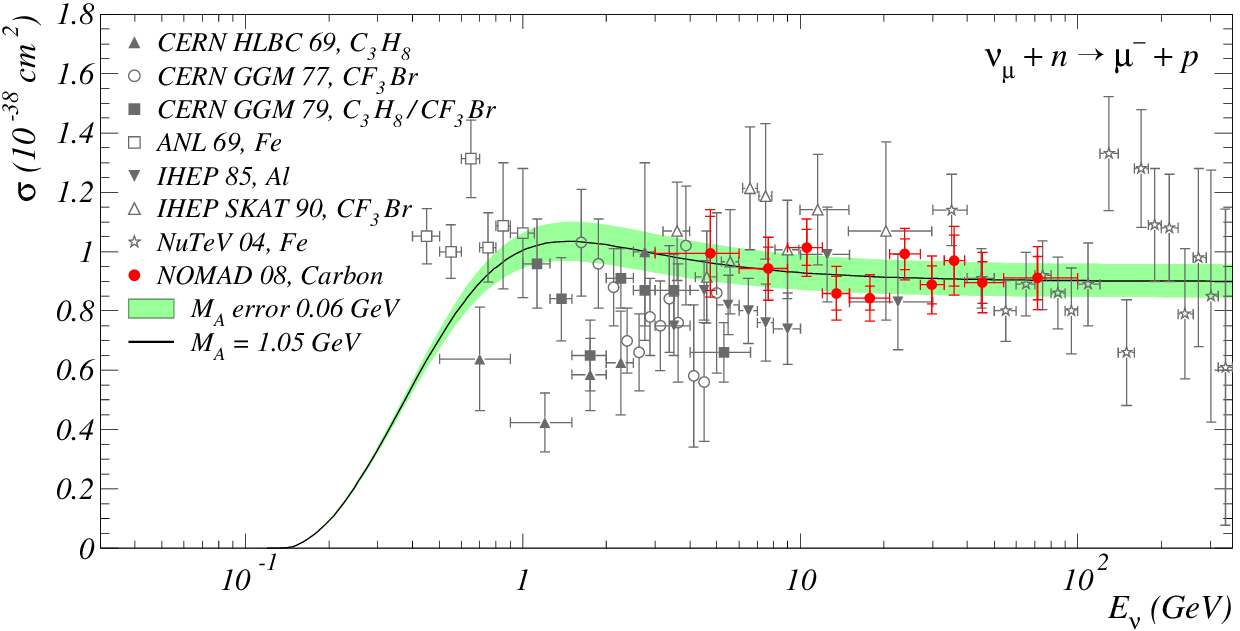
Original figure: NOMAD, Eur. Phys. J. C 63, 355–381 (2009), Fig. 14 (ν), doi:10.1140/epjc/s10052-009-1113-0. Not our work; shown for comparison, all rights with the authors and publisher.
ν̄μ quasi-elastic σ per proton of carbon · Fig. 14 (ν̄)
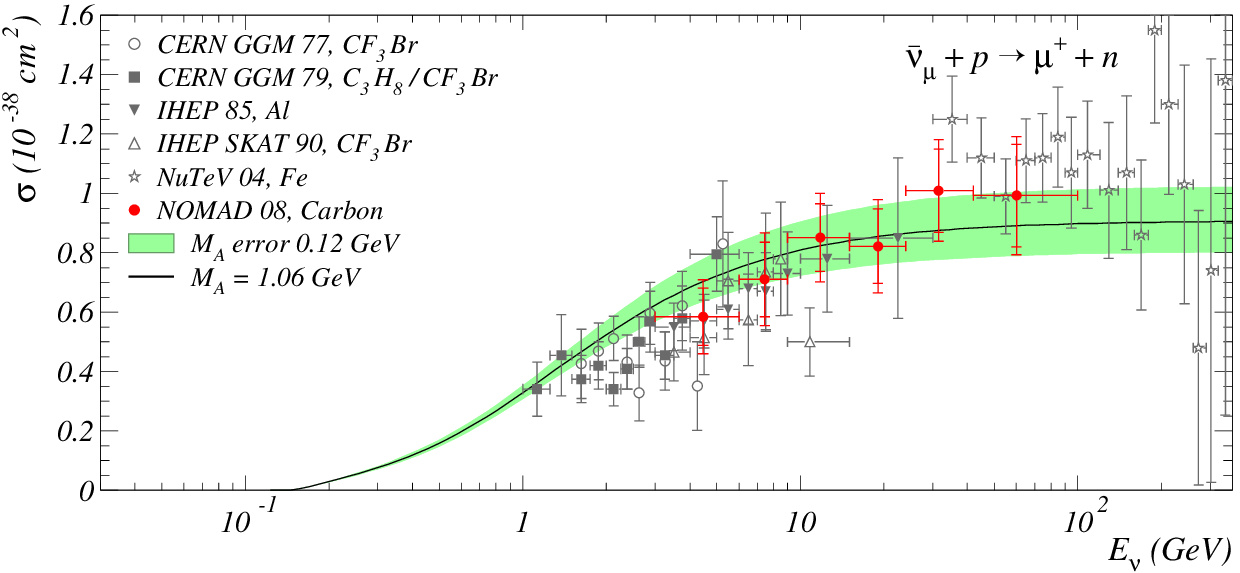
Original figure: NOMAD, Eur. Phys. J. C 63, 355–381 (2009), Fig. 14 (ν̄), doi:10.1140/epjc/s10052-009-1113-0. Not our work; shown for comparison, all rights with the authors and publisher.
νμ n → μ⁻ p on free neutrons: NOMAD (converted) and the deuterium data vs the free-neutron QE of the tunes and the reference · Fig. 15
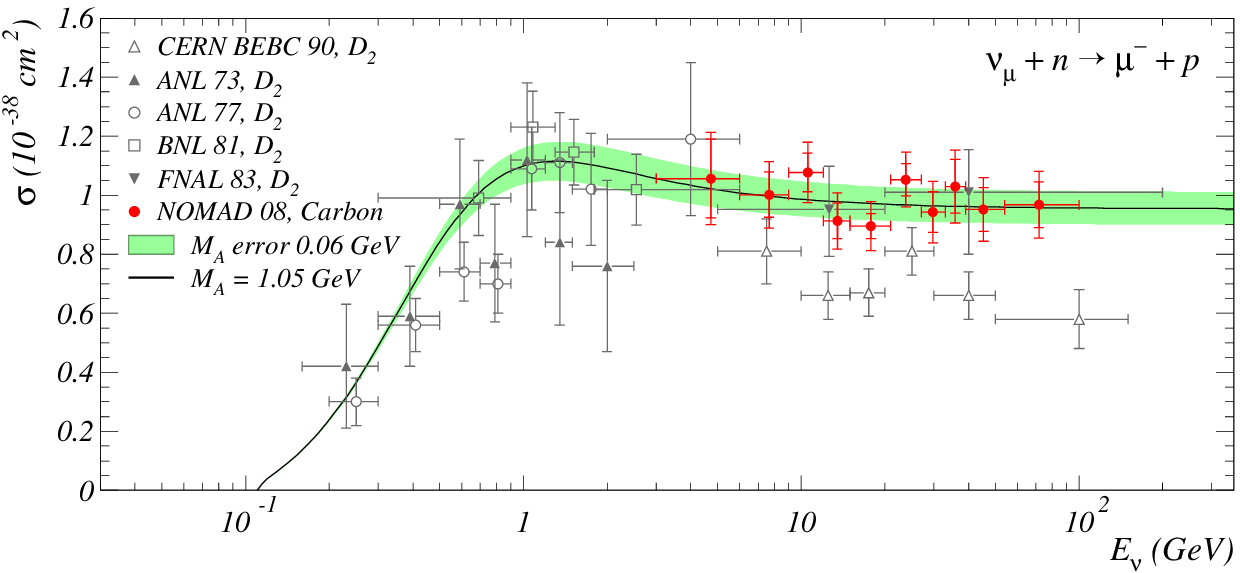
Original figure: NOMAD, Eur. Phys. J. C 63, 355–381 (2009), Fig. 15, doi:10.1140/epjc/s10052-009-1113-0. Not our work; shown for comparison, all rights with the authors and publisher.
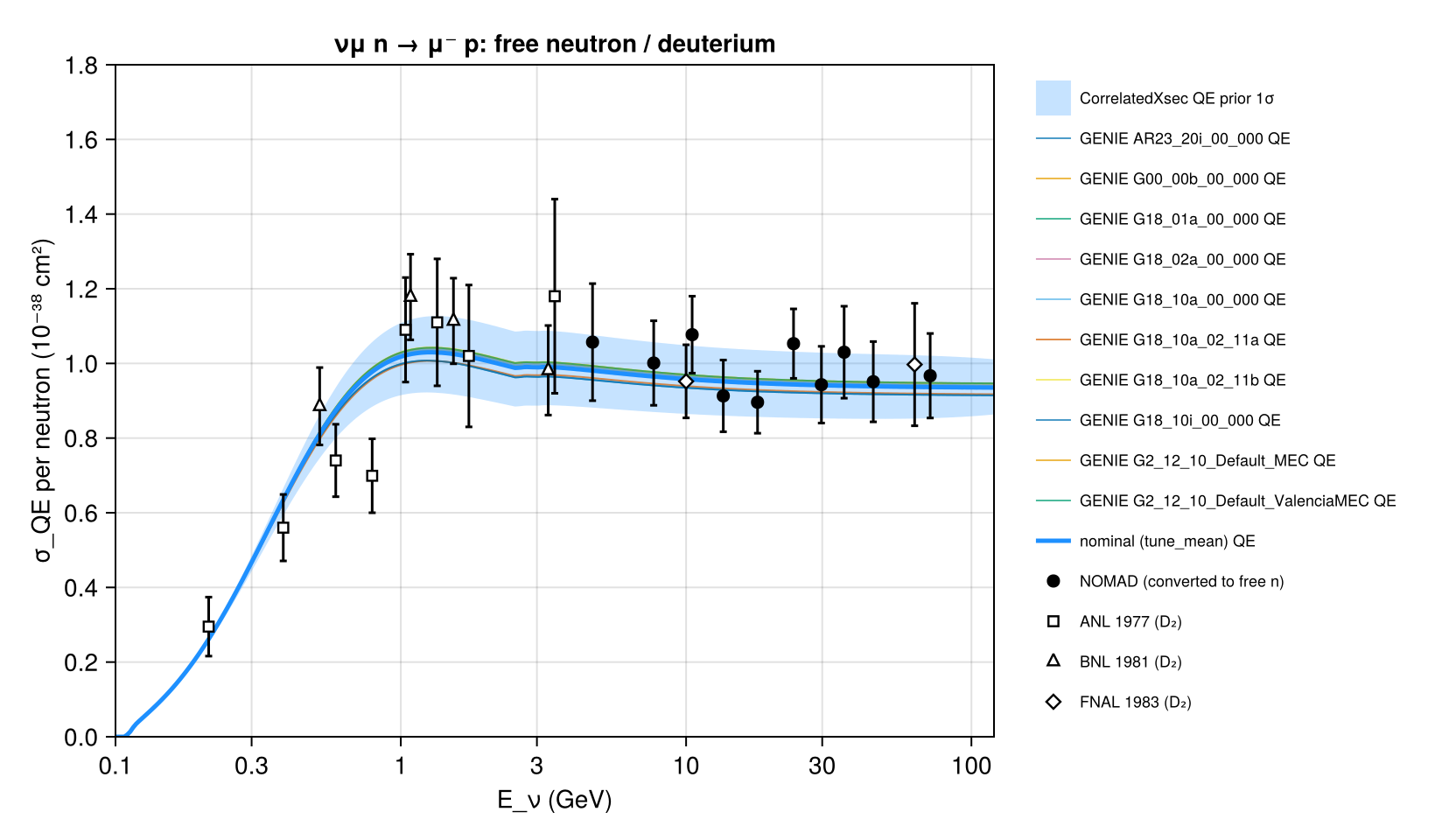
Known limitations
- NOMAD normalised its quasi-elastic sample to its deep-inelastic events (not to a flux prediction) and subtracted about 50 % background with its Monte Carlo; the conversion to a free neutron uses the Smith–Moniz model and is model dependent.
- NOMAD's 'quasi-elastic' signal on carbon is defined by its event selection: 2p2h (MEC) events enter partly. The model is shown both as QE only and QE + MEC; χ² uses QE only.
- The deuterium data are shown per neutron at the geometric bin centres; for ANL the NUISANCE flux-tuned values (Barish 1977) are used. The published HEPData tables differ from the NUISANCE files in a few bins (ANL at 1.02 GeV, BNL first and last bins); the NUISANCE values agree with the points in NOMAD's figure.
- χ² uses stat ⊕ syst as uncorrelated errors at the bin-mean energies. Per struck nucleon: σ per carbon nucleon × 2.
- The prior band on free nucleons contains only the axial-mass and normalisation knobs (the tune-spread modes are defined on nuclei).
Reproduce
git clone https://github.com/Newtrinos-org/Newtrinos.jl.git && cd Newtrinos.jl && git checkout 78e71c310b- Download reproduce.jl and the
data/folder of this entry into an empty directory. julia -t 8 --project=/path/to/Newtrinos.jl reproduce.jl
# NOMAD quasi-elastic νμ and ν̄μ cross sections, 3–100 GeV, on its (mainly carbon) target and converted to free nucleons
# (EPJC 63, 355 (2009); tables from the arXiv:0812.4543 source), with the deuterium bubble-chamber data the paper compares
# to (ANL 1977, BNL 1981, FNAL 1983; NUISANCE data files), compared with the quasi-elastic cross sections of Newtrinos.jl
# (module `xsec`): the GENIE tunes (`generator_sigma`, process QE, and QE + MEC) per neutron (ν) or proton (ν̄) of carbon
# and of free nucleons, and the reference model of `CorrelatedXsec` with its prior 1σ band (for free nucleons only the
# axial-mass and normalisation knobs act; the tune-spread modes are defined on nuclei).
# Run from this directory with the Newtrinos.jl environment at the pinned commit:
#   julia --project=<path to Newtrinos.jl> reproduce.jl
using Newtrinos, CairoMakie, CSV, DataFrames, Printf, Statistics, Random, Distributions

cd(@__DIR__); mkpath("ours"); mkpath("results")
const X = Newtrinos.xsec

readc(f) = CSV.read(f, DataFrame; comment = "#")
Nn, Nb = readc("data/nomad_nu.csv"), readc("data/nomad_nubar.csv")
anl, bnl, fnal = readc("data/anl_d2.csv"), readc("data/bnl_d2.csv"), readc("data/fnal_d2.csv")

tab = X.load_table()
E = 10 .^ range(log10(0.1), log10(120), length = 300)
at(v, e = E) = X.at_energies(tab.E, v, e)
TUNES = Symbol.(sort(tab.tunes))
# σ per struck nucleon: carbon has 6 neutrons and 6 protons out of 12 nucleons → per nucleon × 2; free n / p: per nucleon
pernuc(target) = target === :C ? 2.0 : 1.0
σ_tune(t, target, anti, procs) = at(sum(getfield(X.generator_sigma(t, target, :numu, anti, :CC), p) for p in procs)) .* E .* pernuc(target)

xs = X.configure(X.CorrelatedXsec())
ref = xs.cfg.reference
sigma(target, anti, procs) = (f = xs.sigma(E; flavour = :numu, anti, current = :CC, target, process = procs); p -> f(p) .* E .* pernuc(target))
rng = MersenneTwister(1)
draw() = map(p -> p isa Distribution ? rand(rng, p) : p, xs.priors)
samples = [draw() for _ in 1:500]
p0 = xs.params
q(M, a) = [quantile(r, a) for r in eachrow(M)]
tunecol(i) = (Makie.wong_colors()[mod1(i, 7)], 0.7)

function panel(pos, target, anti, title, ylab, data)
    ax = Axis(pos, xscale = log10, xlabel = "E_ν (GeV)", ylabel = ylab, title = title, limits = (0.1, 120, 0, 1.8),
              xticks = ([0.1, 0.3, 1, 3, 10, 30, 100], ["0.1", "0.3", "1", "3", "10", "30", "100"]))
    fQE = sigma(target, anti, :QE)
    M = reduce(hcat, [fQE(p) for p in samples])
    band!(ax, E, q(M, 0.16), q(M, 0.84), color = (:dodgerblue, 0.25), label = "CorrelatedXsec QE prior 1σ")
    for (i, t) in enumerate(TUNES)
        lines!(ax, E, σ_tune(t, target, anti, (:QE,)), color = tunecol(i), linewidth = 1, label = "GENIE $(t) QE")
    end
    lines!(ax, E, fQE(p0), color = :dodgerblue, linewidth = 2.5, label = "nominal ($(ref)) QE")
    target === :C && lines!(ax, E, sigma(target, anti, (:QE, :MEC))(p0), color = :dodgerblue, linestyle = :dash, linewidth = 2,
                            label = "nominal QE + MEC")
    for (d, lab, mk) in data
        errorbars!(ax, d.x, d.y, d.e, color = :black, whiskerwidth = 4)
        scatter!(ax, d.x, d.y, marker = mk, color = mk == :circle ? :black : :white, strokecolor = :black, strokewidth = 1.2, label = lab)
    end
    ax
end
mid(lo, hi) = sqrt.(lo .* hi)
nomad_c(d) = (x = d.E_mean, y = d.sigma_nucl, e = d.err_tot_nucl)
nomad_f(d) = (x = d.E_mean, y = d.sigma_free, e = sqrt.(d.stat_free .^ 2 .+ d.syst_free .^ 2))
specs = (
    ("nu_carbon", :C, false, "NOMAD νμ QE, carbon", "σ_QE per neutron (10⁻³⁸ cm²)", [(nomad_c(Nn), "NOMAD", :circle)]),
    ("nubar_carbon", :C, true, "NOMAD ν̄μ QE, carbon", "σ_QE per proton (10⁻³⁸ cm²)", [(nomad_c(Nb), "NOMAD", :circle)]),
    ("nu_free", :n, false, "νμ n → μ⁻ p: free neutron / deuterium", "σ_QE per neutron (10⁻³⁸ cm²)",
     [(nomad_f(Nn), "NOMAD (converted to free n)", :circle),
      ((x = mid(anl.E_lo, anl.E_hi), y = anl.sigma_fluxtuned, e = anl.err_fluxtuned), "ANL 1977 (D₂)", :rect),
      ((x = mid(bnl.E_lo, bnl.E_hi), y = bnl.sigma, e = bnl.err), "BNL 1981 (D₂)", :utriangle),
      ((x = mid(fnal.E_lo, fnal.E_hi), y = fnal.sigma_nuis, e = fnal.err_nuis), "FNAL 1983 (D₂)", :diamond)]),
)
for (name, target, anti, title, ylab, data) in specs
    fig = Figure(size = (820, 480))
    ax = panel(fig[1, 1], target, anti, title, ylab, data)
    Legend(fig[1, 2], ax, framevisible = false, labelsize = 9)
    save("ours/$(name).png", fig)
end

# χ² (stat ⊕ syst, uncorrelated; NOMAD's normalisation comes from its DIS sample) of the QE prediction at the bin-mean
# energies, for the reference (with and without its prior spread) and the tunes
function chi2s(d, target, anti; y = :sigma_nucl, err = d.err_tot_nucl)
    fx = xs.sigma(d.E_mean; flavour = :numu, anti, current = :CC, target, process = :QE)
    m(p) = fx(p) .* d.E_mean .* pernuc(target)
    sd = vec(std(reduce(hcat, [m(p) for p in samples]), dims = 2))
    c(mm, extra = 0) = sum((d[!, y] .- mm) .^ 2 ./ (err .^ 2 .+ extra .^ 2))
    tunes = [c(at(getfield(X.generator_sigma(t, target, :numu, anti, :CC), :QE), d.E_mean) .* d.E_mean .* pernuc(target)) for t in TUNES]
    (c(m(p0)), c(m(p0), sd), tunes, m(p0))
end
rows = []
for (lab, d, target, anti, y, err) in (("nu carbon", Nn, :C, false, :sigma_nucl, Nn.err_tot_nucl),
                                       ("nubar carbon", Nb, :C, true, :sigma_nucl, Nb.err_tot_nucl),
                                       ("nu free (NOMAD converted)", Nn, :n, false, :sigma_free, sqrt.(Nn.stat_free .^ 2 .+ Nn.syst_free .^ 2)))
    c0, cb, ct, m0 = chi2s(d, target, anti; y, err)
    push!(rows, merge((dataset = lab, ndf = nrow(d), reference = c0, reference_with_prior = cb,
                       mean_data_over_reference = mean(d[!, y] ./ m0)), NamedTuple(Symbol(t) => v for (t, v) in zip(TUNES, ct))))
end
out = DataFrame(rows)
CSV.write("results/chi2.csv", out)
show(stdout, out, allrows = true, allcols = true); println()
Provenance
| Newtrinos.jl commit | 78e71c310b (xsec (generator_sigma, CorrelatedXsec)) |
|---|---|
| Run date | 2026-10-12T12:25:11Z |
| Wall time | 1.4 min (4 threads) |
| Julia | 1.12.5 |
| Machine | AMD EPYC 7702P 64-Core Processor, 128 hardware threads, Linux |
| Environment | newtrinos_Manifest.toml · run.toml |
Downloads
CSV files hold one row per scan point: the scanned and profiled parameters
(sin2_theta23, dm2_32 in eV², dcp in rad, nuisance parameters), dchi2 = −2Δ log L
and the log-likelihood. JLD2 files contain the full NewtrinosResult objects.
| File | Size | SHA-256 |
|---|---|---|
| ours/nu_carbon.png | 192.2 kB | 32cd9ed3e01a… |
| ours/nu_free.png | 173.4 kB | 6cd47e14d0cc… |
| ours/nubar_carbon.png | 181.0 kB | 6fd4ce0a4f2d… |
| results/chi2.csv | 1017 B | d555d06379f1… |